Our Gardens
The Wedding Garden
The first garden at Pacifica, terraced by Craig Dent (with the help of Pacifica’s excavator). It was established to host weddings on the property — a beautiful setting, and one of Pacifica’s first sources of income.
The Rock Garden
Designed by world-renowned rock-garden designer Josef Halda of the Czech Republic, and built in 2002 with the help of neighbor Bob Ettner (retired from the Forest Service). It features a 60-foot waterfall and remains a work in progress with great potential to this day.
The Western Native Plant Garden
Developed in 2011 and designed by Ray and Larry McDowell (who also built the nursery and Blue Sky reservoir). Small hills and winding paths traverse the garden, and a small ephemeral pond fills with rain each spring, just as a natural seasonal pond would. Look for native conifers and shrubs such as Ceanothus, Garrya, and fall-colored Vine Maple.
The Fragrance Garden
A lovely place to sit or walk, centered on a labyrinth that Peg built rock by rock one summer. It holds a wide selection of fragrant plants from Forestfarm and is a delight in any season. A few to watch (and smell) for:
- Early spring: White Forsythia (Abeliophyllum), Azara, Daphne, Sarcococca
- Late spring: Lily of the Valley (Convallaria), Mock Orange (Philadelphus), Lilac
- Early summer: Mexican Orange (Choisya), Honeysuckle (Lonicera), Old Roses
- Late summer: Butterfly Bush (Buddleia), Summersweet (Clethra), Phlox paniculata
- Fall: Abelia koreana, Katsura (Cercidiphyllum), Glory Bower (Clerodendrum)
The Pollinator Garden
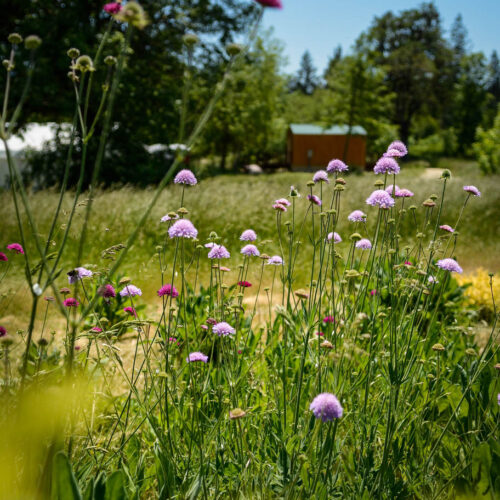
Designed and planted by Ray soon after the Fragrance Garden, along one edge of the community gathering field behind Cedar Center. It holds a wide variety of plants that support pollinators through every season — and lists are available for plants that support specific bees and butterflies.
Flowers and insects evolved together, adapting to one another. Bees favor blue-violet (with yellow a close second): bee balm, lavender, aster, and Echinacea. Butterflies prefer a large landing platform and the colors red and yellow, though they like blue too — some favorites are aster, goldenrod, milkweed, black-eyed Susan, and sage.
The Drive
A garden running the length of the half-mile drive into Pacifica, designed and planted by Greg Mason for color in every season: spring crabapples and lilacs; crape myrtle and other summer-flowering trees; fine fall maple and liquidambar foliage; and colorful conifers in winter. Large “windows” in the foliage open up to the mountain views.
Children’s Orchard
Created in 2025 with the help of the Organic and Permaculture Garden Club, this delightful orchard and garden was a longtime dream brought to life. It includes semi-dwarf (child-sized) apples, pears, and plums, along with blueberries and strawberries.
Maple & Shade Garden
Below Heron Pond, in the shade of madrones and pines, you’ll find wonderful Japanese Maples and other shade-loving plants that put on spectacular fall color.
The Pioneer Garden
This garden surrounds the “Old Williams Post Office,” built in the 1940s and used for more than 30 years before being rescued, moved to Pacifica, and made into a small museum. Its plants echo the gardens of the pioneer era: lilacs, an apple tree, and perennials such as phlox and daylilies, alongside prairie wildflowers like black-eyed Susan and Echinacea.
Sequoia Sanctuary
Part of the sculpture garden and the Art & Nature Trail (ANT), the Sequoia Sanctuary is a long-term land art project envisioned by board member Richard Reames: a great circle of giant Sequoias forming a secluded green room without a roof — a living cathedral for the ages.
On February 18, 2023, more than 60 volunteers planted 113 Sequoiadendron trees. The young giants are hitting their stride — most added around 15 inches in their first full year, and one shot up an astonishing 33 inches. Students from Pacifica’s Outdoor School (PODS) measure each tree every spring and fall, learning to track growth over time. Learn more about the project here.
Even now, visitors feel a sense of calm and wonder inside the circle — and it’s easy to imagine how magical it will become as the trees grow taller and older.
Mother Tree Border
An effort to preserve some of the “Mother Tree” stock plants accumulated by Ray and Peg over the years. This arboretum border circles the current Forestfarm area, safe inside the fence (away from deer) and close to water.